Offline Attribution: The Next Frontier for Experiential Marketing
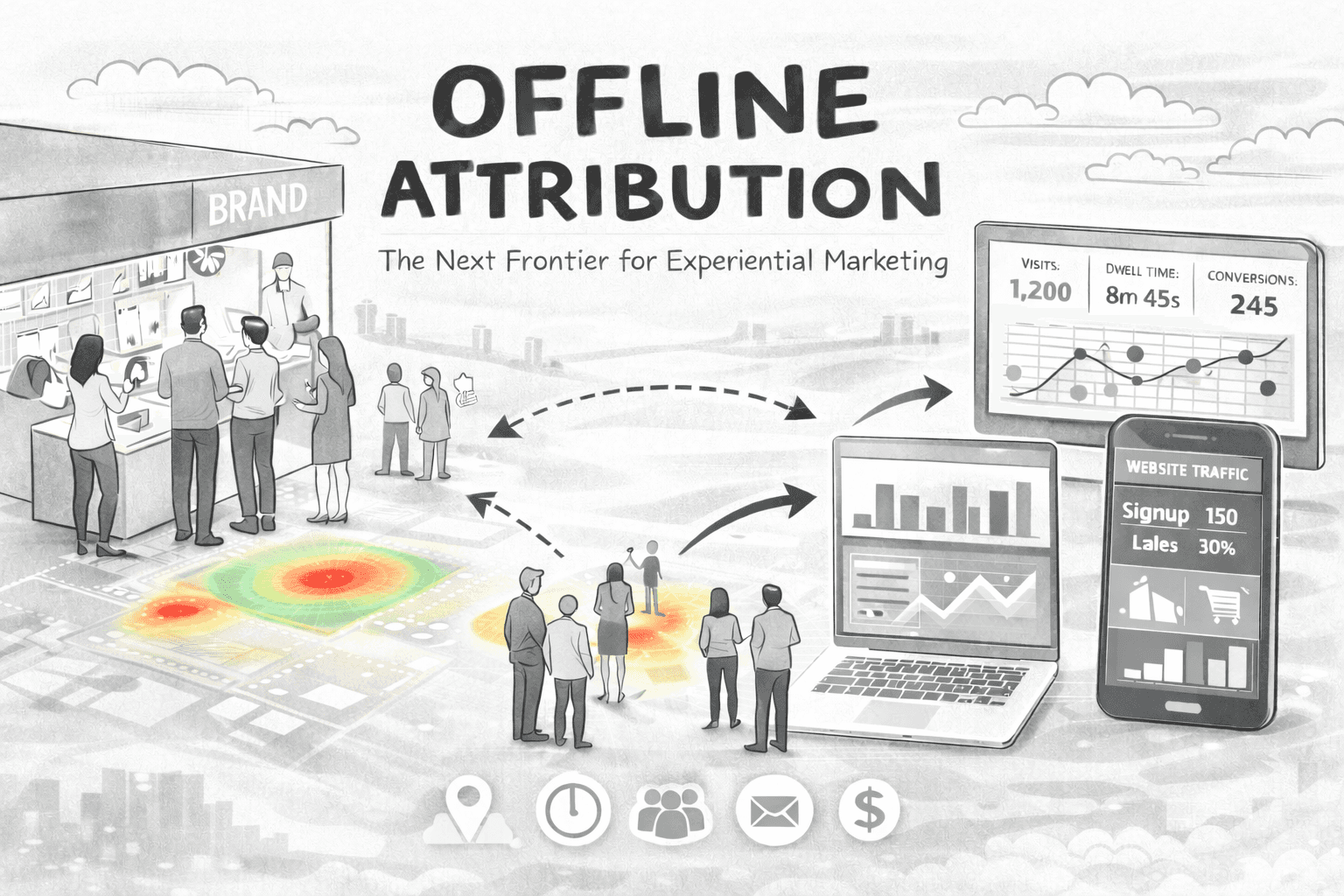
For the last decade, marketing data lived almost entirely online.
We tracked clicks, impressions, funnels, conversions, and user journeys down to the millisecond.
But something interesting is happening in 2026.
Brands are pouring more budget into real-world experiences: pop-ups, festivals, expos, field marketing, brand activations, retail concepts, and live events.
These channels create something digital cannot match: physical presence.
You can touch products, talk to humans, try things, watch reactions, and see behavior unfold in real time.
There is just one problem:
The real world has been mostly immeasurable.
Online, marketers can answer:
Who clicked
What page did they land on
How long did they stay
Where they dropped off
Offline, it has traditionally been:
Did people show up
Did it feel busy
Did exhibitors seem happy
Did we get any leads
The gap between those two worlds is finally closing.
That gap is called offline attribution.
Why Offline Attribution Matters Now
Brands are investing heavily in experiential channels again.
According to industry surveys, experiential budgets grew faster than digital ads for the first time since 2010.*
When real world spend increases, accountability follows closely behind.
Executives are asking:
Did foot traffic increase
Did the right audience attend
Where did they go
How did they engage
What booth or experience created the most value
Did we influence purchasing behavior later
These are attribution questions.
Not surface-level attendance questions.
Actual business questions.
The tension is simple:
Marketers want to justify physical spend with the same confidence they have online.
Offline attribution unlocks that.
From “Was It Busy” to “What Happened and Why”
Historically, real-world success was measured by vibes:
Foot traffic looked good
People seemed engaged
We think the booth performed well
Those are valid observations, but they are not data.
Offline attribution adds clarity:
Traffic
How many people entered a spaceDwell
How long did they stayFlow
Where they moved nextEngagement
Which zones created interestConversion moments
Where intent appeared or stalled
This turns a 2-day pop-up or 4-day expo into something measurable.
And when something is measurable, it can be improved.
The New Attribution Funnel for Physical Spaces
The online marketing funnel is well understood:
Awareness → Consideration → Purchase
In real-world environments, there is a similar funnel emerging:
Presence → Interest → Engagement → Outcome
Here is how it looks:
Presence:
Did someone show upInterest:
Did they move toward specific zones or boothsEngagement:
Did they dwell, interact, ask questions, or take a cardOutcome:
Did they visit a website later, sign up, or purchaseThis gives event organizers and brands a common language for offline performance.
Offline Attribution Links Offline to Online
The most powerful part of offline attribution is not just measuring what happens in the moment.
It is how physical interactions influence digital behavior later.
Example signals:
Post-visit website traffic
Product page views
Newsletter sign-ups
Social follows
Purchases
Experiential is not just about the booth or the festival or the pop-up.
It is about how those encounters drive digital impact days or weeks later.
For the first time, offline touchpoints can be mapped to online outcomes.
What This Means for Organizers and Exhibitors
If you run an event, expo, or trade show:
You can prove value to exhibitors with real data
You can price based on traffic and dwell instead of proximity and guesswork
You can optimize layouts for flow and safety
You can attract brands that expect data and ROI
If you are an exhibitor or sponsor:
You can validate whether the right audience attended
You can compare booth performance across events
You can justify the budget to leadership
You can make smarter go or no-go decisions next time
Offline attribution creates transparency for both sides.
Why Offline Attribution Is Emerging in 2026
Three shifts are making this happen now:
Brands need new channels
Digital ads are noisy, expensive, and less effective than they used to be.
Experiential provides differentiation.The tools to measure the real world exist
Computer vision, spatial intelligence, and indoor positioning have matured.
Executives expect data everywhere
Any channel without data feels risky.
Add those together, and you get a market ready for offline attribution.
Where Sense+ Fits In
Sense+ focuses on the spatial part of the attribution problem.
Digital data tells you what happens before and after an event.
Spatial data tells you what happened inside the event.
With privacy-safe sensors, heatmaps, dwell metrics, and flow insights, organizers and exhibitors can answer the questions that used to be guesswork.
It is not about surveillance, and it is not about identity.
It is about understanding how spaces perform and how people move through them.
Offline attribution becomes possible when these spatial signals connect to the broader marketing stack.
The Future Is Blended
The next generation of marketing attribution will not be online or offline.
It will be blended.
Digital channels create awareness.
Physical channels create belief and experience.
Digital channels convert.
Offline attribution is simply the missing link.
And 2026 is the year that the link becomes visible.
Curious how offline attribution could work at your event
Explore Sense+
Sense+ See Clearly.
Real-time intelligence for real-world events.